
Failure Analysis of a High-Strength Steel Bolt: A Case of Proactive Accident Prevention

High-strength steel bolts are essential components in structural applications. While they are designed to withstand substantial loads, their failure can have catastrophic consequences. A common mode of failure in bolts is fatigue, a damage mechanism that occurs gradually over time due to cyclic loading. This case study examines a high-strength steel bolt that failed due to fatigue, exploring the root causes and offering guidance on preventing similar incidents.
Background
The bolt in question was part of the steel support structure for an overhead trolley crane at a manufacturing facility. During a routine walkthrough, maintenance personnel found a fragment of the bolt on the plant floor beneath the crane. The bolt came from a six-bolt joint between two steel members in the structure. Concerned about the implications, the manufacturer sought to understand the cause of failure and how to avoid a potential crane collapse.
Visual and Macroscopic Examination
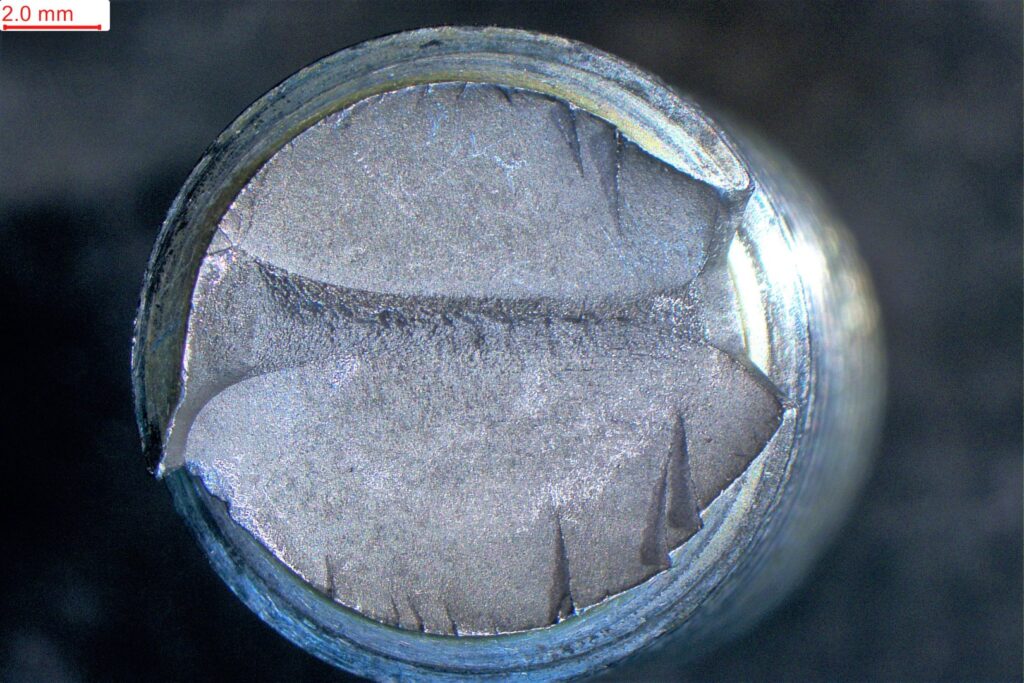
A preliminary visual inspection of the failed bolt revealed telltale signs of a specific type of fatigue failure known as reverse bending fatigue. The fracture surface showed several key features:
– Two smooth, diametrically opposed fracture surfaces with beach marks on them, indicating fatigue
– Ratchet marks along the outer edges of the cracks, indicating more than one origin
– A rough area between the two fatigue cracks, indicating the final fracture zone
– No evidence of corrosion that might have contributed to the failure
Macroscopic examination revealed that the cracks had initiated at a thread root, which is a common stress concentration point in bolted connections.
Microscopic and Metallurgical Analysis
Further investigation using a scanning electron microscope (SEM) revealed:
Fatigue striations, confirming progressive crack growth over numerous cycles.
Absence of nicks, dents, and gouges, ruling out physical damage as a contributing factor.
No material defects, ruling out manufacturing flaws as a possible cause.
Chemical analysis using optical emission spectroscopy (OES) verified that the bolt was made from a high-strength steel alloy. Rockwell hardness testing showed it had the appropriate core hardness for the specified grade. And metallographic analysis confirmed that the bolt had the type of steel microstructure expected for high-strength steel bolts with rolled threads. These findings eliminated the possibility of improper material selection or processing as contributing factors.
Root Cause of Failure
After considering the results from laboratory analysis, the design of the bolted joint, the bolt installation practices at the facility, and the expected loading conditions of the bolted joint, CTL Engineering concluded that the root cause was that the failed bolt was probably under-torqued when it was installed.
Prevention and Mitigation Strategy
To prevent similar failures in the future, CTL Engineering recommended to the client that:
– All six bolts in the joint should be replaced with new bolts of the same size and grade specified by the trolley crane manufacturer, and
– The replacement bolts should be tightened using a calibrated torque wrench, following the manufacturer’s specification for bolt tightening sequence and torque values.
Conclusion
Fatigue failure in high-strength steel bolts continues to be a significant concern in structural applications. This case study highlights the importance of understanding failure mechanisms and enforcing proper installation procedures. By optimizing design, preload conditions, and surface treatments, engineers can significantly enhance bolt reliability, ensuring safety and proper performance in critical assemblies.
