Strength Beneath the Surface: How Soil Stabilization Improves Construction Efficiency and Cost

When most people picture a construction project taking shape, they imagine the walls going up or the pavement being poured. But long before that happens, the success of any structure begins with what’s beneath it — the soil. For engineers and contractors, understanding soil conditions is one of the first and most critical steps of a project. When those soils are weak, wet, or unstable, one solution is increasingly being used across Ohio and beyond: soil stabilization.
What Is Soil Stabilization?
Soil stabilization is the process of improving the engineering properties of native soils to make them suitable for construction. Instead of removing poor soil and replacing it with imported aggregate, stabilization modifies the soil in place using chemical additives.
According to Tyler Rudd, Project Manager at CTL Engineering’s Columbus office, the process is becoming more common across large-scale projects.
“When you expose the subgrade during site preparation, sometimes that soil simply isn’t suitable for construction,” Rudd explains. “It may be too wet, too soft, or lack the strength needed to support a building or pavement. Traditionally, we would undercut those areas—excavate and replace them with aggregate. But more contractors are realizing that stabilizing the soil in place can be faster, more efficient, and often more cost-effective.”
The chemical additives—often cement, lime, quicklime, or lime kiln dust—react with the minerals in the soil to dry it out, reduce plasticity, and increase strength. The result is a more stable base that can support a building foundation, parking lot, or roadway without the need to truck in tons of stone.
Why It’s Becoming More Common
While soil stabilization has been around for decades, Rudd says it’s appearing on job sites with increasing frequency.
“It’s not a new concept,” he says, “but we’re seeing it specified more often because it delivers consistent results and helps control costs. My sense is that pricing for the materials and equipment has become more competitive, and owners are seeing the benefits in reduced trucking and faster schedules.”
Those savings can be substantial. Removing unsuitable soil means paying for excavation, trucking, disposal, and replacement materials—all of which add cost and time. Chemical stabilization can reduce or eliminate those steps, especially when dealing with expansive sites or roadways.
“The larger the project, the greater the benefit,” Rudd explains. “For a small building pad, it might still make sense to remove and replace poor soil. But for something large—like a jail site or a roadway—stabilizing what’s there avoids moving thousands of cubic yards of material. You’re saving time, money, and logistics.”
How the Process Works
The success of a soil stabilization project starts in the lab. Before any material is applied in the field, CTL’s soils team tests the existing conditions to determine the best approach.
“We start by collecting soil samples and determining characteristics like clay content, strength, and moisture,” says Rudd. “Based on those results, we decide which modifier—cement, lime, or another material—will achieve the best results.”
High-clay soils tend to respond best to lime products, while lower-clay soils benefit more from cement. CTL then performs a mix design, blending small samples of the native soil with different percentages of the chemical additive—typically ranging from 0% to 8% by weight.
“Those lab tests tell us how the soil reacts,” Rudd continues. “We’ll compare samples with 4%, 6%, or 8% additive and identify the point where strength gain levels off. That allows us to recommend the most cost-efficient percentage for the field.”
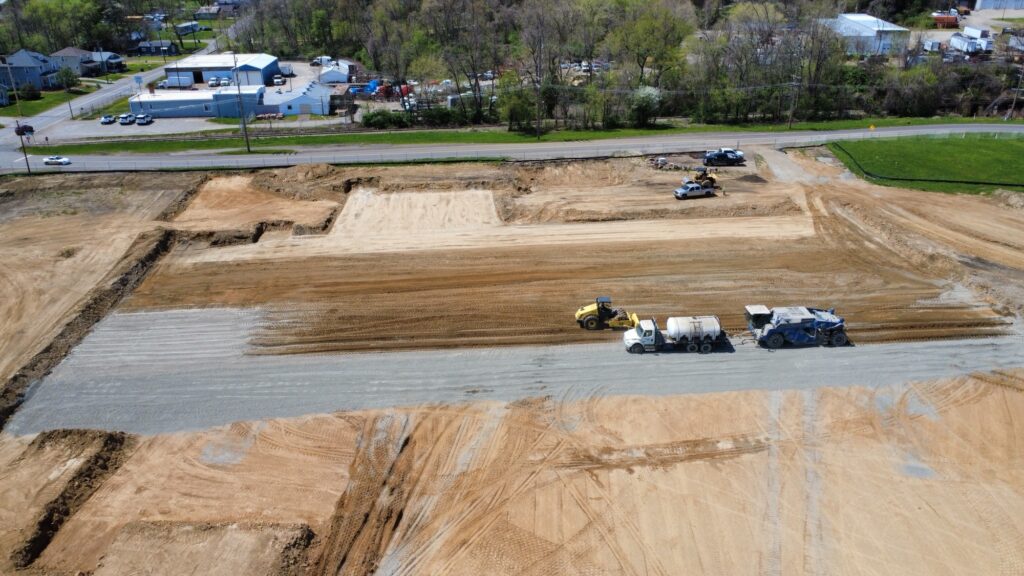
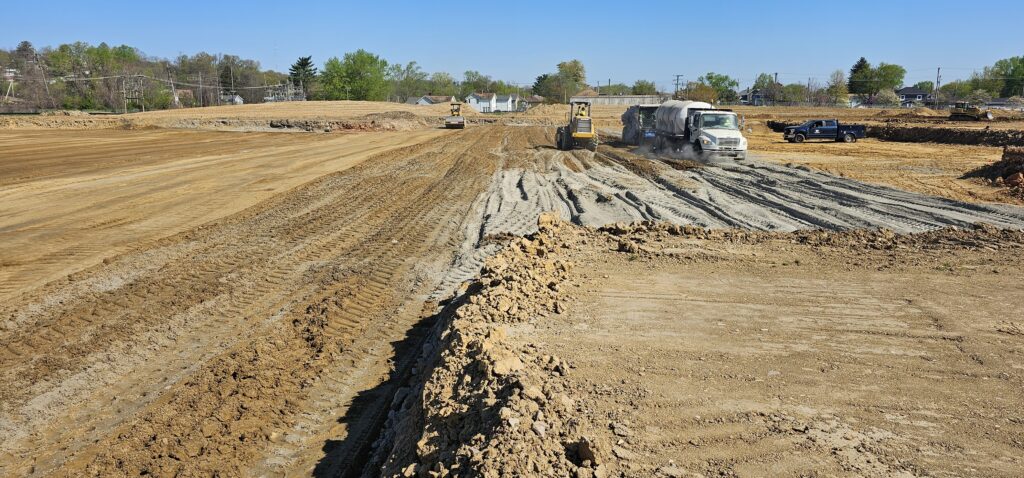
Once the mix design is complete, the contractor applies the chemical modifier across the site. Specialized equipment spreads the material evenly on the surface, then blends it into the soil with large rotary mixers. Rollers compact the treated soil to achieve the target density.
CTL then verifies that density in the field using a nuclear density gauge—a device that measures compaction and moisture content. Field results are compared to lab data to confirm that the stabilized layer meets project specifications.
“We test at regular intervals—every hundred feet or so, depending on project size,” Rudd explains. “That ensures uniformity and confirms that the in-place material is performing as designed.”
Meeting ODOT and Project Specifications
In Ohio, many stabilization projects follow Ohio Department of Transportation (ODOT) guidelines for strength gain and performance. The agency sets minimum benchmarks to ensure that chemically modified soils achieve a measurable increase in bearing capacity.
“Our lab testing provides data that aligns with ODOT acceptance criteria,” Rudd says. “The stabilized soil needs to demonstrate a defined increase in strength compared to the original. Those benchmarks give contractors and owners confidence that the material will perform long-term.”
While each project has unique conditions, the consistency of ODOT’s standards provides a reliable framework for both engineers and contractors to evaluate success.
When to Consider Soil Stabilization
Soil stabilization can be used on a range of projects, but it’s particularly beneficial when:
- The site has soft or saturated soils that would otherwise require extensive excavation.
- Large building pads, roadways, or parking lots are planned, where undercutting would be costly.
- Schedule constraints demand quicker turnaround—since stabilization can often be completed in days, not weeks.
- There’s a need to reuse on-site materials, reducing environmental impact and trucking emissions.
Rudd points out that CTL’s team has recently used the process successfully on several notable projects:
- Muskingum County Jail (Zanesville, OH) – The new facility was built on soft, wet soils. “We stabilized the entire building pad, and now it’s hard as a rock,” says Rudd. “The contractors even joked later that it was almost too hard to dig through—definitely a good problem to have.”
- Dublin Scioto High School Addition – A parking lot expansion where stabilization corrected poor soils and shortened the construction schedule.
- Eiterman Road Extension (Dublin, OH) – A roadway project where stabilization provided a strong, consistent subgrade across long stretches of alignment.
In all three cases, CTL provided both the lab mix design and the field testing to ensure proper performance.
The Role of Testing and Collaboration
One advantage CTL brings to the table is its in-house soils laboratory, which allows seamless collaboration between testing and field operations.
“Our geotechnical and materials testing teams work side by side,” Rudd explains. “The soils lab typically performs the initial subsurface exploration, so by the time we mobilize, we already know if the upper few feet contain weak material. That coordination helps us plan stabilization or other soil improvement methods early in the process.”
This internal collaboration means CTL can move quickly from analysis to design to verification—all within the same team. It also ensures data consistency between lab and field, reducing communication gaps that can occur when testing is outsourced.
A Blend of Chemistry and Engineering
Rudd describes soil stabilization as a fascinating intersection of disciplines.
“It’s really a blend of chemistry, engineering, and construction,” he says. “You’re taking native soil and transforming it into something structurally sound. Watching that process unfold in real time on a project site is rewarding—it’s not something you see every day.”
For contractors, that transformation is tangible. A site that once felt spongy underfoot can, within a day, become firm enough to support heavy equipment. For owners and engineers, the benefits show up in budget savings, faster schedules, and longer-lasting performance.
The Environmental Advantage
Beyond cost and schedule, soil stabilization also offers environmental benefits. By reusing existing soils instead of replacing them, projects minimize waste, reduce the number of truck trips, and preserve nearby borrow pits or quarries. The smaller carbon footprint aligns well with modern sustainable construction goals.
Additionally, stabilized soils often perform better under variable moisture conditions, reducing the likelihood of future settlement or failure. That means fewer repairs, less maintenance, and extended pavement or foundation life cycles.
Looking Ahead
As demand for efficient, sustainable, and cost-effective site solutions grows, soil stabilization will likely continue to expand across Ohio’s construction landscape. CTL’s role—as both a testing partner and technical advisor—ensures that contractors and owners get the most reliable data and results possible.
“It’s a proven technique that continues to evolve,” Rudd concludes. “At CTL, we’re helping clients apply it in smarter, more strategic ways—using data and testing to drive decisions that make sense for each project.”
