
More Concrete Suppliers Switch to Portland Limestone Cement, Opening New Environmentally-Friendly Options for Construction


By David A. Breitfeller, PE
As one of the leading concrete testing facilities in Ohio, CTL Engineering regularly tests new mix designs produced by local concrete suppliers in their AASHTO-accredited materials laboratories. This gives CTL unique insight into the changing concrete market and what products are available.
In recent months, local suppliers have had a big push to begin using Portland Limestone Cement (PLC, or ASTM C595 Type IL), a change that can reduce concrete carbon emissions by as much as 10 percent.
In Ohio, this change has been largely prompted by the Ohio Department of Transportation, which released a memo earlier this year that allows for a 1:1 replacement of Type I and Type I/II (traditional) cement with Portland Limestone Cement in concrete mix designs.
But although ODOT prompted many suppliers to formulate new mix designs using PLC, the shift will likely also be highly beneficial for architects and others looking to reduce carbon emissions on their construction projects as more environmental concrete enters the local market.
A more environmentally friendly cement
According to the World Business Council for Sustainable Development, the cement industry is one of the two largest producers of carbon dioxide, creating up to 8% of the worldwide man-made emissions. But concrete cannot be formed without cement, and most of the built environment relies on concrete.
Although green cement has been around for several decades, it has not been used commonly in Ohio. Each supplier has slightly different concrete mix designs, based on the aggregate available to them and the proportions of water, cement, and entrained air mixed in. Any changes to suppliers’ formulas mean changes to the strength and durability of the concrete. So, most suppliers have a number of mix designs that have different specific properties.
However, Portland Limestone Cement, also known as Type IL, has become an increasingly standard material in ready-mixed concrete. It has gained attention specifically because it performs similarly to Portland Cement (traditional cement), resulting in concrete with similar attributes.
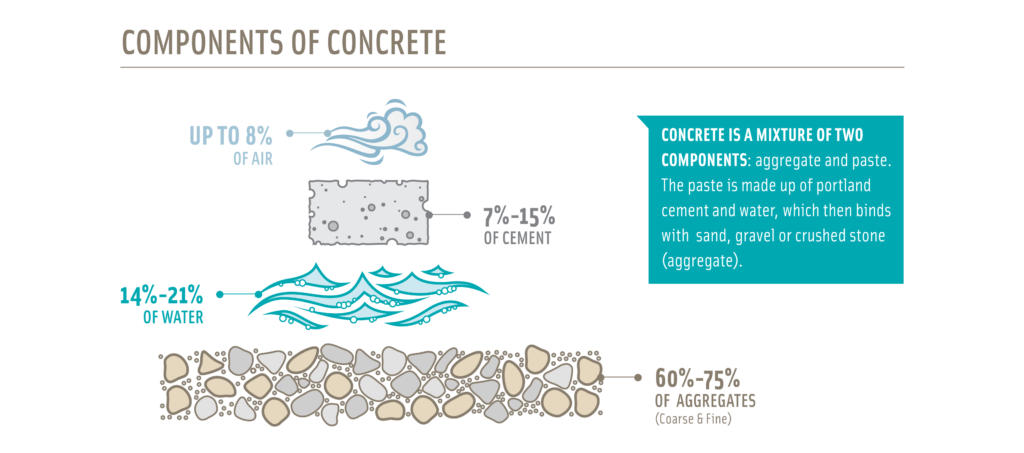
Concrete is a mix of cement, water, air, and aggregates. Image courtesy of cement.org.
Equally important, Portland Limestone Cement is engineered with a higher limestone content than Portland Cement and reduces the carbon footprint of concrete by about 10%.
PLC is already used in transportation infrastructure ranging from residential driveways to highways to bridges in many states.
“Concretes made with PLC have performed well worldwide and have been subjected to decades of testing by cement manufacturers, ready mix concrete producers and specifying agencies,” according to Ohio Concrete, the state-wide association of concrete suppliers.
PLC switch led by ODOT
In February, the Ohio Department of Transportation announced it would allow a 1:1 replacement of Type I and Type I/II cements with PLC in existing approved ODOT concrete mixtures.
Since then, several local suppliers have worked to confirm the properties of their mixes incorporating PLC, working with CTL Engineering to test them for strength and permeability.
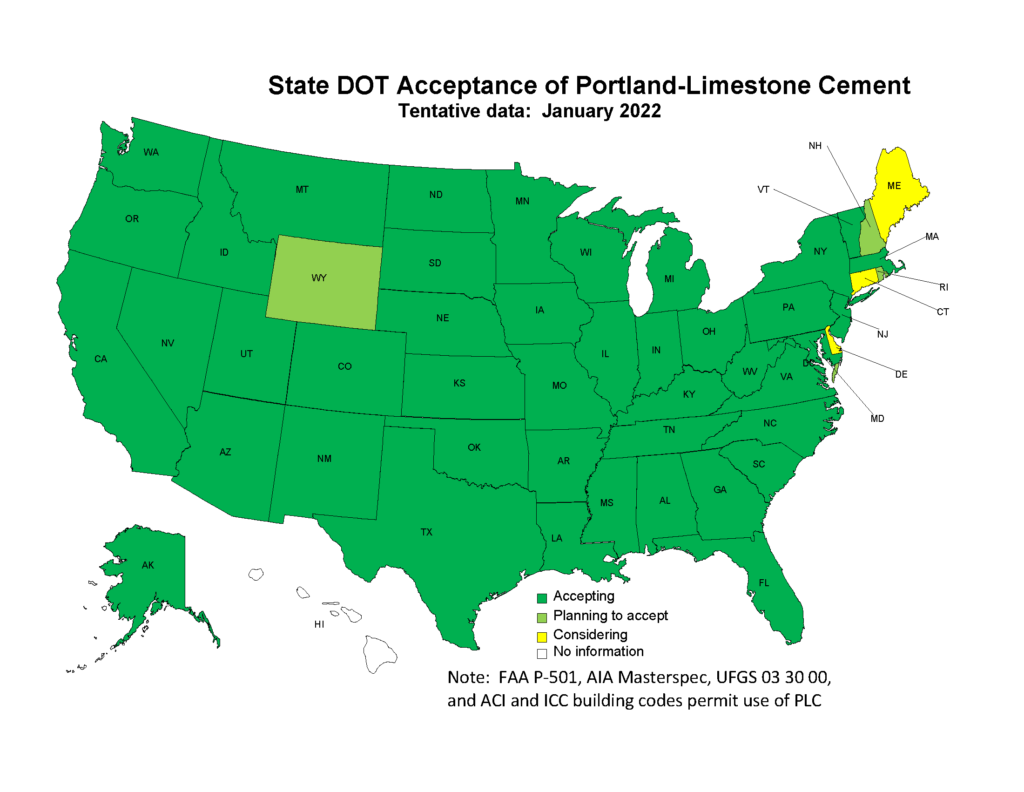
State DOT Acceptance of Portland-Limestone Cement, map courtesy of greenercement.com
Although a 1:1 substitution is now allowed by ODOT, ultimately, producers need to know the properties of their concrete and have test data accredited by an AASHTO Materials Lab to use it widely.
CTL works with suppliers to test fresh concrete for workability and entrained air content and hardened cylinder samples for compressive strength, flexural strength, and rapid chloride permeability, among other tests.
So far, the results from early testing in the laboratories are positive, and the 1:1 substitution is working out as expected for most suppliers.
Increased PLC Availability Good News for Architects and Builders
Although suppliers are switching to PLC formulas to support ODOT objectives, it is also good news for architects and builders who will benefit from the increased availability of environmentally-friendly concrete.
Particularly as architects search for ways to reduce carbon output and overall environmental impact, suppliers that have already produced PLC concrete for transportation will likely have the confidence to offer new formulas to the building industry as well.
Although PLC concretes have been around for some time, this is the first time many Ohio producers have experimented and confirmed through testing that the concrete produced with the new mixes has the same strength and durability as the concrete they had previously made.
Ultimately, the new formulas developed for transportation projects will likely benefit several markets searching for more environmentally friendly products.
For more information about CTL concrete testing, reach out via the form below.
David A. Breitfeller, PE, Vice President and Technical Manager
Dave is a Registered Professional Engineer, a Vice President, and the Technical Manager of CTL Engineering. He has nearly 50 years of experience with inspection, quality assurance and quality control of construction materials including soils, concrete, asphalt, masonry, structural steel and fireproofing. His projects range from transportation to infrastructure to buildings, including Special Inspections of structural construction following International Building Code requirements.
