Strategic Funding: Helping Clients Move Projects From “On Hold” to Funded


Every community has important projects waiting for funding.
Whether it’s improving transportation infrastructure, replacing aging utilities, expanding public safety facilities, enhancing parks and recreation, or supporting economic development, many worthwhile projects remain on hold – not because they lack value, but because they lack a clear funding strategy.
For many local governments, annual budgets and Capital Improvement Programs (CIPs) can only address a portion of their long-term needs. As priorities compete for limited resources, projects are often delayed for years despite their significant public benefit.
This is where Strategic Funding becomes an essential part of project delivery.
Strategic funding is much more than preparing a grant application. It is the process of identifying the right funding opportunities, developing projects that are competitive, aligning funding strategies with project goals, preparing successful grant applications, and supporting clients throughout implementation and compliance after funding has been awarded.
For CTL, strategic funding creates opportunities to engage with clients earlier, solve funding challenges proactively, and provide support throughout the complete project lifecycle from planning through project delivery.
Recognizing Funding Opportunities Early
Project Managers are often the first professionals to hear clients say:
“We need this project, but we don’t have funding.”
Those conversations create opportunities to introduce strategic funding early in project development.
Rather than promising grant success, Project Managers should ask questions that determine project readiness.
Examples include:
- Is the project already designed but unfunded?
- Does it improve public safety?
- Does it provide environmental benefits?
- Does it improve mobility?
- Does it strengthen economic development?
- Is it identified in the Capital Improvement Program?
- Has the community adopted a Master Plan or Safety Action Plan?
- Is local matching funding available?
- Can the client successfully manage grant compliance after award?
These conversations shift the discussion from simply needing money to identifying projects that are truly fundable.
Thinking Beyond Traditional Funding
Many funding opportunities exist outside a client’s annual operating budget or traditional capital improvement program.
Communities today have access to a wide variety of funding sources, including:
- Federal discretionary grants
- State infrastructure programs
- Regional commissions
- Public safety funding
- Water and wastewater infrastructure programs
- Environmental funding
- Economic development initiatives
- Rural development programs
- Appalachian development funding
- Legislative appropriations
Federal opportunities are searchable through Grants.gov, while transportation funding is frequently available through the U.S. Department of Transportation for roadway safety, multimodal transportation, freight mobility, bridges, transit, and local infrastructure improvements.
Programs such as Safe Streets and Roads for All (SS4A) support both planning and implementation of roadway safety projects, while INFRA focuses on nationally and regionally significant freight and highway investments.
Other specialized opportunities include:
- FEMA SAFER Grants
- Assistance to Firefighters Grants (AFG)
- Appalachian Regional Commission (ARC)
- Drinking Water and Wastewater State Reserve Programs
- Economic Development Administration (EDA)
- State Revolving Funds
The first step is simply knowing these programs exist. The next step, and where the real value lies, is understanding which funding opportunity best aligns with a client’s project, whether the project is eligible, how competitive it may be, and what information should be developed long before the application period opens.
Understanding the Grant Lifecycle
One of the biggest misconceptions about grants is that the process begins when a Notice of Funding Opportunity (NOFO) is released.
In reality, successful projects often begin months – or even years – before applications are accepted.
Communities that consistently secure funding don’t wait for opportunities to appear. They continuously prepare projects so they are ready when funding becomes available.
Grant funding is best understood as a project lifecycle rather than a single application. From identifying a community need to completing construction and closing out the grant, every phase builds upon the one before it.
The strongest projects are those that have been thoughtfully planned long before funding opportunities become available.
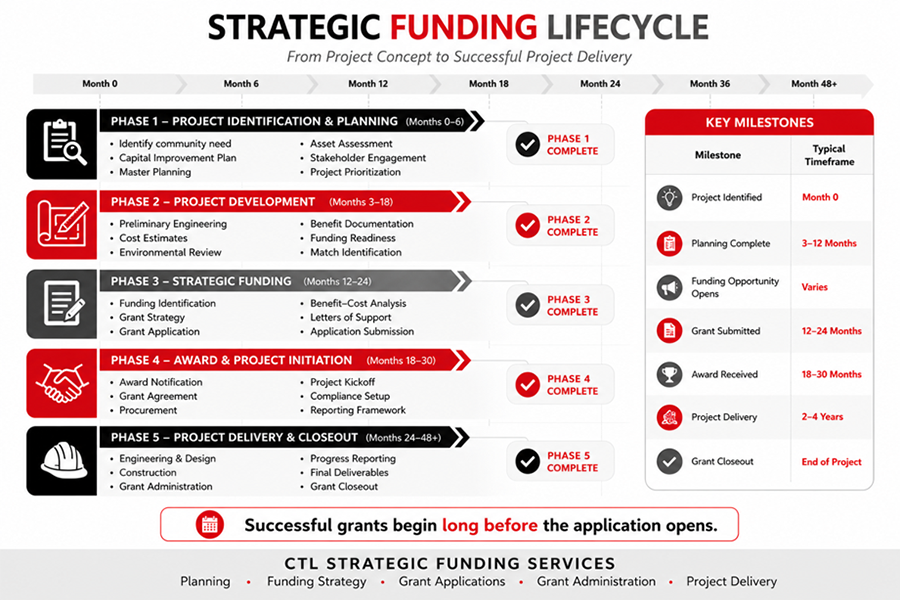
Figure 1. The Strategic Funding Lifecycle illustrates how successful projects progress from identifying a community need through planning, project development, funding strategy, grant application, award, implementation, and project closeout. While every project is unique, most grant-funded projects require approximately 2 – 4 years from concept to completion.
Building Funding-Ready Projects
Different funding programs support different phases of project delivery.
Planning grants may fund:
- Feasibility studies
- Master Plans
- Safety Action Plans
- Asset inventories
- Data collection
- Public engagement
Implementation grants may support:
- Engineering
- Design
- Construction
- Roadway improvements
- Water and wastewater infrastructure
- Multimodal transportation
Public safety grants may support:
- Staffing
- Equipment
- Training
- Emergency response
Environmental programs often support:
- Drinking water
- Wastewater
- Stormwater
- Watershed protection
- Resiliency
Economic development funding frequently supports:
- Downtown revitalization
- Tourism
- Workforce development
- Industrial infrastructure
- Broadband
- Community capacity
Clients are most competitive when projects are prepared before funding opportunities are announced.
Project readiness typically includes:
- Clearly defined scope
- Reliable cost estimates
- Preliminary engineering
- Mapping
- Benefit-Cost Analysis (when required)
- Community support
- Environmental review
- Matching funds
- Implementation schedules
- Grant administration planning
For clients with multiple unfunded projects, CTL can help develop a Funding-Ready Project Inventory, identifying which projects are prepared for implementation funding, which are better suited for planning grants, and which require additional development before becoming competitive.
How Strategic Funding Strengthens Project Delivery
A successful grant application requires much more than compelling writing.
It requires:
- Sound engineering
- Realistic budgets
- Detailed schedules
- Technical documentation
- Project justification
- Benefit-Cost Analysis
- Compliance planning
- Environmental documentation
- Implementation strategies
This is where CTL provides exceptional value.
Rather than offering standalone grant application services, CTL integrates strategic funding with planning, engineering, environmental services, construction management, and project delivery.
That means clients receive support throughout the entire project lifecycle – not simply during the application phase.
Where funding programs allow, CTL also helps clients structure project budgets so eligible project development, strategic funding, and grant administration services may be incorporated into the overall project budget.
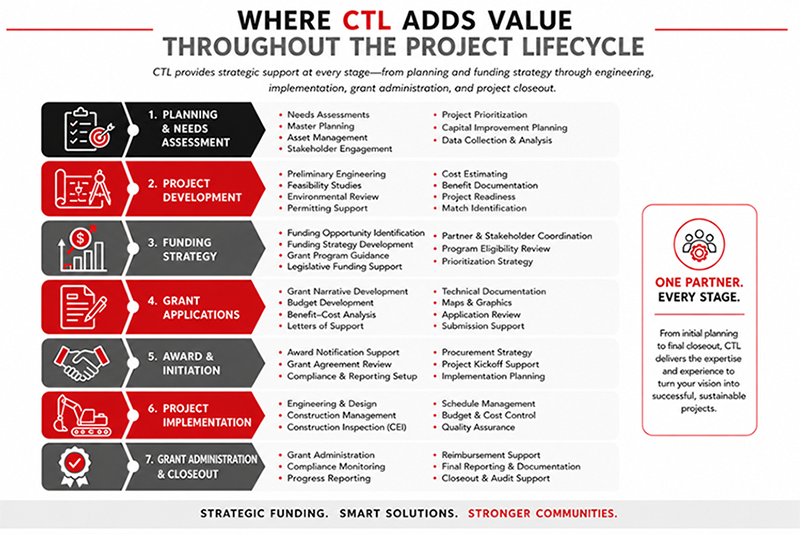
Figure 2. CTL provides strategic support throughout every stage of project delivery – from planning and funding strategy through engineering, implementation, grant administration, and project closeout – creating a seamless path from concept to completion.
Proven Results
CTL’s strategic funding experience has helped municipalities, universities, utilities, and community partners secure more than $70 million in awarded funding across federal and state programs.
Recent examples include:
North Carolina
- $275,271 SS4A Planning Grant – Town of Elizabethtown
- $940,176 FEMA SAFER Grant
- $16 million NC DEQ State Reserve Program application
West Virginia
- $13.4 million USDOT Multimodal Project Discretionary Grant – City of Bluefield
- $25.7 million SS4A Implementation Grant
- $420,000 Transportation Alternatives Program
- $10.4 million USDOT RAISE Grant – West Virginia University
Virginia
- $895,466 Quarter Branch Road Watermain Replacement
- $1,092 Million Equalization Basin at WWTP
- $308,000 Second Elevated Water Tower
- $375,000 Sewer Main Lining Study
- $2,702 Million Waterline Redundancy and Looping
Why Strategic Funding Matters & Bringing it All Together
Communities should not have to postpone important projects simply because funding is unavailable today. Strategic funding provides a roadmap that connects community priorities with state, federal, and regional investment opportunities.
For Project Managers, it means recognizing funding opportunities early and helping clients prepare projects before application windows open. For clients, it means having a trusted partner who understands both funding strategy and technical project delivery.
For CTL, it means delivering far more than successful grant applications. It means helping clients move projects from vision to reality.
Strategic funding is not simply about winning grants—it is about helping communities transform ideas into projects that improve infrastructure, strengthen public safety, enhance quality of life, and create long-term economic opportunities.
The most successful projects don’t begin when a funding opportunity is announced. They begin months—or even years—earlier through thoughtful planning, sound engineering, strategic partnerships, and project readiness.
By integrating strategic funding with planning, engineering, environmental services, and project management, CTL helps clients navigate every phase of the grant lifecycle—from identifying a need to delivering a completed project.
Whether a client is just beginning to explore funding opportunities or is ready to submit a competitive application, CTL provides the experience, technical expertise, and strategic guidance needed to move projects from concept to completion.
